This is a discovery tour of the Moorish past of Andalusia and one of the many pearls of the province of Cordoba, Medina Azahara, a beautifully restored castle in Almodóvar del Rio. We enjoy a nice lunch in Palma del Rio and stroll through the beautiful white city of Ecija to see the sun setting over the rolling olive groves at Estepa.
The making of Spain
This summer I saw the BBC series “The making of Spain” with Simon Sebag Montefiore, who takes us on an exciting journey through the history of Spain. From the early years of the Iberian Peninsula, across the reconquista to present-day Spain.
Spain is European, but throughout history it’s always looking towards Africa, which is only 14 km away.
Due to its location at the southernmost tip of Europe, and its proximity to Africa, it is a unique mix of cultures and people.
Jews, Muslims and Christians have conquered and recaptured the country and left their mark. This is what makes Spain so special and exotic.
From paganism to Islam and Catholicism, to Franco’s dictatorship and its current democracy, from the Atlanic ocean to the Mediterranean. The series highlights every aspect of society, who and what shaped the soul of this peninsula and is therefore the perfect introduction for a visit to our beautiful region.
The series highlights many cities that are within a stones throw from our cortijo, but one has attracted my special attention: Medina Azahara.
So I take a look at the map, google a few thins, look into my travel books and voila, half an hour later the perfect day trip is mapped out.
Medina Azahara is an hour’s drive from our Cortijo. We leave at 8 am, have breakfast en route and arrive around 9.30 am at the visitor’s centre. Perfect, because it’s hot and I want to visit the ruins before noon.
History
The Medina Azahara are the ruins of a large walled Arab city, some 8 km west of Cordoba.
Construction started between 936 and 940 by order of Abd al-Rahman III, the ruler of the Córdoba Caliphate and further completed by his son Al-Hakam II.
The government seat of Al-Andalus. was located within the city limits
Al-Andalus is the name the Moorish conquerors gave to the part of the Iberian Peninsula they had conquered. Around that time it covered what is now Spain and Portugal, plus part of North Africa.
Already in 1010, Medina Azahara was conquered and destroyed as a result of the civil war
(Fitna de al-Ándalus) that brought the Caliphate to ruin. In the following centuries the looting continued and the precious building material was used for the construction of later structures.
From 1910, the excavation of the ruins started. So far, only about 10% of the 112-hectare area has been uncovered and since 2018 the ruins have been UNESCO World Heritage Sites
Visit
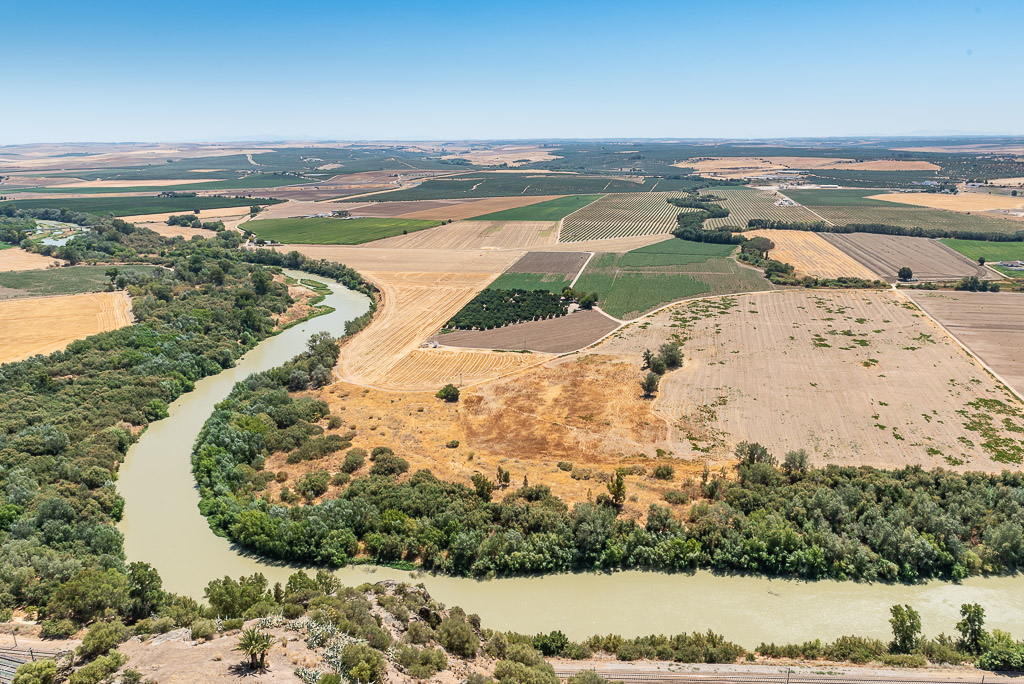
Access to the ruins is free. You only buy a ticket for the bus ride from the visitor center to the site itself for 2.5 euros per person. It is about 2 km which you can also cover on foot. However, this is not advisable on a hot (summer) day, so we wisely take the bus. At the visitor center you can first watch the educational video about the origin and life within the Medina (every half hour). There is also a nice museum where various pieces are exhibited that were found during the excavations.The bus ride takes 5 minutes and leads us to the upper part of the ruins, which you can explore further from here at your own pace (you can also book a guide). The parts where the excavations are still underway, are not accessible to the public, but even without this access a visit to this beautiful complex is more than worthwhile. The view alone over the Cordobese plains is breathtaking. We clearly see why Abd-al Rahman III chose this place to build a palace for his beloved.
I close my eyes and imagine this place full of lush gardens, halls covered in marble and shady courtyards.We wander through the site with its crumbled walls, mosaic floors and stately arches. A whole new world comes to life.
The city was laid out over three artificial terraces. At the top was the royal palace, the middle level was for the government buildings and at the bottom were the residences and the mosque.
We descend all the way to the lower city. It’s getting pretty hot, so the climb back up is not an easy one. Do not forget to bring enough water if you do this in summer or in warm weather.
Back at the top, the bus has just arrived to take us back to the visitor center and parking lot.
Almodovar del Rio
Too early for lunch, we decide on a stopover in Almodóvar del Rio, about 20 km from Medina Azahara.
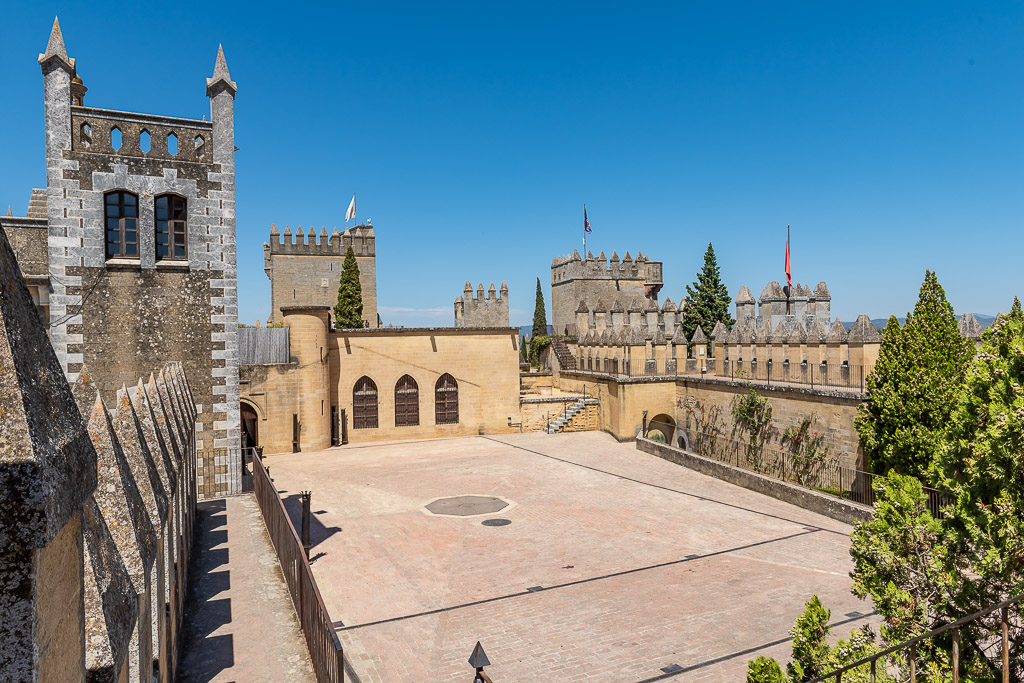
The Castle of Almodovar del Rio played an extremely important role in the defense of the surrounding area because of its strategic location on a hill, next to the river Guadalquivir. The traces of multiple cultures, including Islam and Christianity, can be demonstrated in the architectural style of this unique building. In the year 756 this fort became the estate of the Moorish prince Al’del Malik Ben Qatan and from 758 it fell into the hands of the emirate of Cordoba in the reign of Abderraman I.
In the 19th century, Almodovar del Rio was known as Almudawar Al-Adna, while the castle was called Castillo de Almudawar. During the 10th century it was completely tied to the Caliphate of Cordoba, and in the 10th and 12th centuries it belonged to the Taifa of Carmona, then to the Taifa of Seville and finally to the Almohad empire.
Moorish king Abed Mohammed de Baeza would later die at the gates of the castle in the 13th century in 1226, the year in which the fort fell into Christian hands after it was handed over to Fernando III “The Saint”.
From now on the castle would be subjected to successive extensions initiated by the Castilian kings D. Pedro I of Castile and Enrique II of Trastamara
The renovation of the castle started in 1902. Only in 2001 it was opened to the general public.
Various scenes from the 7th season of Game of Thrones were recorded here. There is even a special tour explaining the various scenes of the series.
We were especially struck by the beautiful restoration. Try to get to the top of one of the many lookout towers to enjoy an unforgettable view of the surrounding landscape.
So, if you like castles, knights and Game of Thrones, then this your place !
Palma del Rio
2 pm and our stomachs are starting to growl. Time to consult Tripadvisor. I see some good reviews for a restaurant in Palma del Rio, I launch Waze and off we go.
Upon approach, we think we have entered the wrong address, because the streets are deserted, all shutters are closed and nothing that even looks like a restaurant. Until we see one small parasol and a few chairs. This might be it. And indeed, as we enter we are welcomed by a pleasant buzz.
And tripadvisor didn’t let us down. Casa Manolo appears to be a winner. A friendly waiter assigns us a table and we order two glasses of Protos (Ribera del Duero) .It tastes like heaven.
The suggestions look very tempting … After some hesitation, we decide upon a Ceviche, artichokes al Cordobese (alcachofas al Cordobese), suckling pig with tempura vegetables (lechón confitado con verduras and tempura) and for dessert grandma’s cake (tarta de la abuela) and a turón ice cream (Helado de turón), all washed down with a few glasses of Protos and two coffees.
We pay a whopping 50 euros and leave all satisfied !
Even though it is siesta time, we decide to drive up to the central square (Plaza de Andalucía) in Palma del Rio, which is deserted at this hour. Like all squares in Spain, it is surrounded by beautiful buildings, church towers and decorated fountains.
The heat is scourching, so we flee back into the car, turn on the air conditioning and continue our journey to Ecija, one of the lesser-known white towns of Andalusia. Ecija is located in the Campiña, an area that covers the countryside between Seville and Cordoba.
As we drive across the river and my eye catches the shady promenade. We park our car and decide upon a siesta under the stately poplars. We close our eyes, listen to the silence, the rustling of the trees and the rippling of the water. No living soul for miles around, because this city is known as the ‘frying pan’ of Andalusia. No shit. It’s 6 pm and 35 degrees in the shade. No wonder we are exhausted.
After this enjoyable break we are ready to attack the city, which seems deserted. It feels like everyone fled the town.
The compact center is dotted with Gothic and Mudéjar palaces, churches and baroque towers, hence its nickname ‘la ciudad de las torres’ or ‘city of the towers’. The Roman ruins, on the other hand, bear witness to a rich Iberian center. The city flourished in the 1st and 2nd centuries under the name Colonia Augusta Firma Astigi and provided the Roman Empire with olive oil, among other things.
In 1755 a devastating earthquake destroyed much of the town and many of the current church towers date back to the time when everything was rebuilt.
One of the more beautiful is the tower of the Santa Maria church, which is located on a square just off the Plaza de España.
Close by is the most iconic building of Ecija, the Palacia de Peñaflor. The 18th century palace cannot be visited inside, but you can enjoy the beautiful exterior with its curved facade, ornamental portal, wrought-iron balconies and remains of flamboyant frescos
Desperate for some refreshment, we flee into a cafe, but the air conditioners can’t handle the temperature, so we take to the terrace near the Santa Maria church and enjoy a refreshing cola and the view. Still only a few souls on the street. Is the Spanish interior really emptying ? Are all yougsters fleeing to the coast and abroad to find jobs ? Many houses are for sale, but we also lots of buildings being completely renovated and refurbished. I sincerely hope that these beautiful white villages and towns will remain populated and that the soul, richness and history of the ‘real’ Spain will be preserved.
We will do our very best to keep promoting the beauty and authenticity of the Campo.
Not looking at the map, we follow our gut feeling and wander through the narrow streets, discovering picturesque squares, colorful facades and shady parks.
And surprise, surprise, we automatically end up at our car.
We have one last stop to make on this trip. Estepa and its ‘Balcon de Andalucia’.
From a distance we see the whitewashed town perched against the hillside. Following the signs to ‘Cerro de San Cristobal’ and ‘Castillo’, the highest point in the city we drive up to the highest point.
.
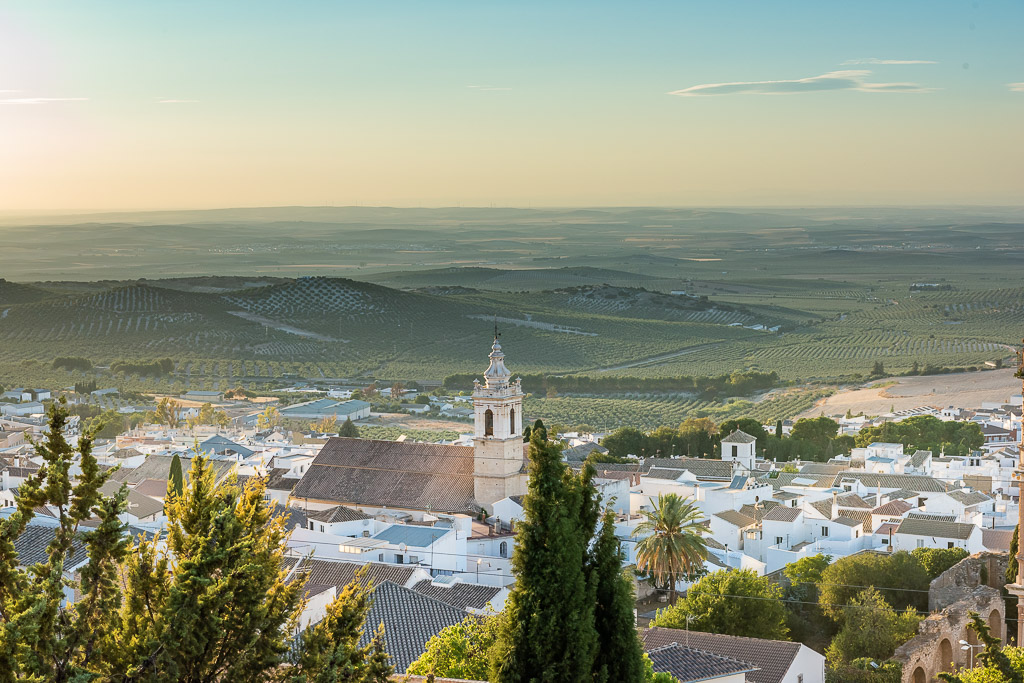
The view is breathtaking. We look out over the city, the surrounding olive groves and neighboring villages. It is a feast for the eyes.
The setting sun completes the picture.
A perfect end to a perfect day