Andalucía’s Moorish past

This is a discovery tour of the Moorish past of Andalusia and one of the many pearls of the province of Cordoba, Medina Azahara, a beautifully restored castle in Almodóvar del Rio.  We enjoy a nice lunch in Palma del Rio and stroll through the beautiful white city of Ecija to see the sun setting over the rolling olive groves at Estepa.

The making of Spain

This summer I saw the BBC series “The making of Spain” with Simon Sebag Montefiore, who takes us on an exciting journey through the history of Spain. From the early years of the Iberian Peninsula, across the reconquista to present-day Spain.
Spain is European, but throughout history it’s always looking towards Africa, which is only 14 km away.
Due to its location at the southernmost tip of Europe, and its proximity to Africa, it is a unique mix of cultures and people.

Jews, Muslims and Christians have conquered and recaptured the country and left their mark. This is what makes Spain so special and exotic.
From paganism to Islam and Catholicism, to Franco’s dictatorship and its current democracy, from the Atlanic ocean to the Mediterranean. The series highlights every aspect of society, who and what shaped the soul of this peninsula and is therefore the perfect introduction for a visit to our beautiful region.
The series highlights many cities that are within a stones throw from our cortijo, but one has attracted my special attention: Medina Azahara.

So I take a look at the map, google a few thins, look into my travel books and voila, half an hour later the perfect day trip is mapped out.

Medina Azahara is an hour’s drive from our Cortijo. We leave at 8 am, have breakfast en route and arrive around 9.30 am at the visitor’s centre. Perfect, because it’s hot and I want to visit the ruins before noon.

History

The Medina Azahara are the ruins of a large walled Arab city, some 8 km west of Cordoba.

Construction started between 936 and 940 by order of Abd al-Rahman III, the ruler of the Córdoba Caliphate and further completed by his son Al-Hakam II.
The government seat of Al-Andalus. was located within the city limits
Al-Andalus is the name the Moorish conquerors gave to the part of the Iberian Peninsula they had conquered. Around that time it covered what is now  Spain and Portugal, plus part of North Africa.
Already in 1010, Medina Azahara was conquered and destroyed as a result of the civil war
(Fitna de al-Ándalus) that brought the Caliphate to ruin. In the following centuries the looting continued and the precious building material was used for the construction of later structures.
From 1910, the excavation of the ruins started. So far, only about 10% of the 112-hectare area has been uncovered and since 2018 the ruins have been UNESCO World Heritage Sites

Impressions

Visit

Access to the ruins is free. You only buy a ticket for the bus ride from the visitor center to the site itself for 2.5 euros per person. It is about 2 km which you can also cover on foot. However, this is not advisable on a hot (summer) day, so we wisely take the bus. At the visitor center you can first watch the educational video about the origin and life within the Medina (every half hour). There is also a nice museum where various pieces are exhibited that were found during the excavations.The bus ride takes 5 minutes and leads us to the upper part of the ruins, which you can explore further from here at your own pace (you can also book a guide). The parts where the excavations are still underway, are not accessible to the public, but even without this access a visit to this beautiful complex is more than worthwhile. The view alone over the Cordobese plains is breathtaking. We clearly see why Abd-al Rahman III chose this place to build a palace for his beloved.

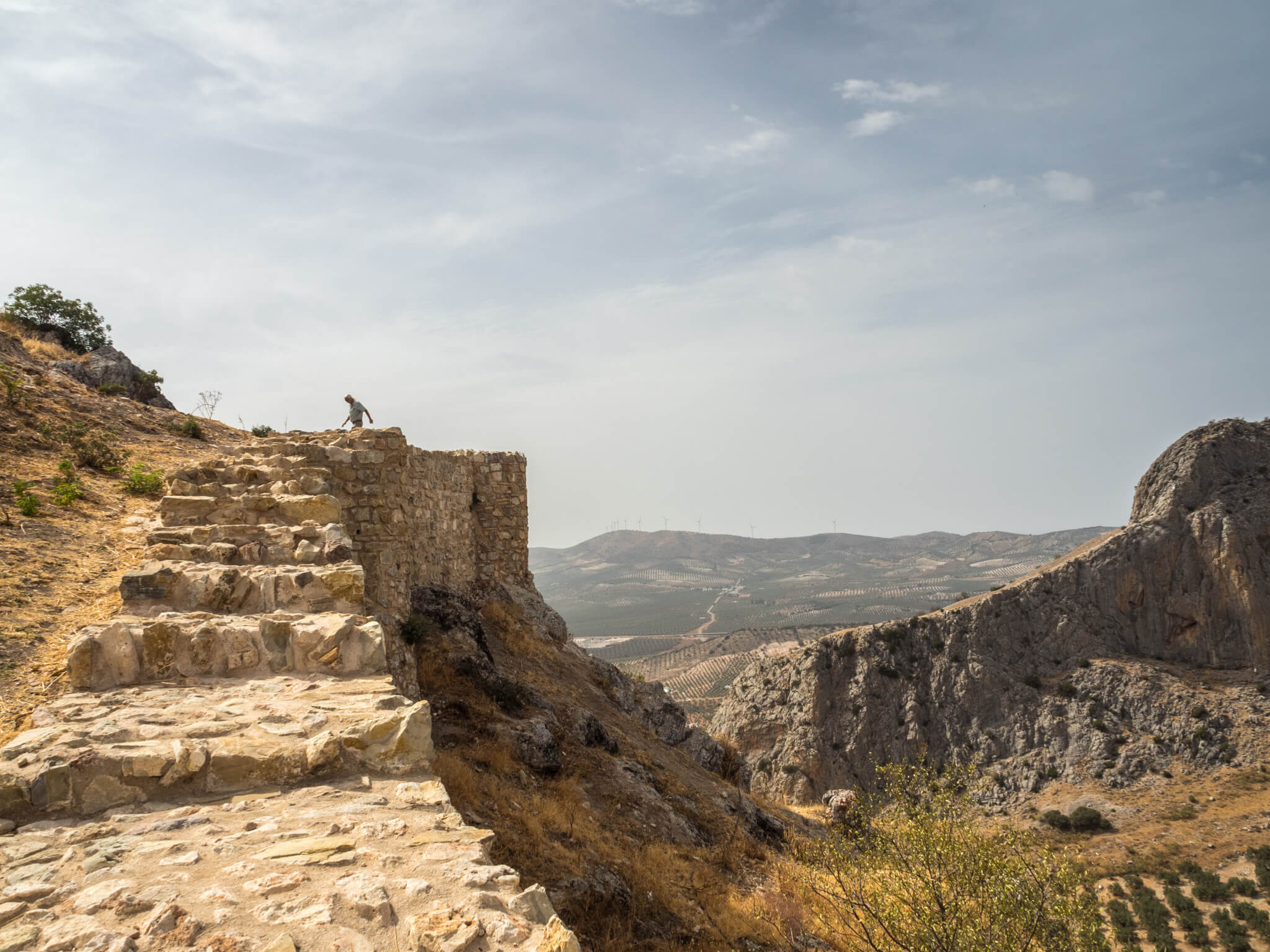
I close my eyes and imagine this place full of lush gardens, halls covered in marble and shady courtyards.We wander through the site with its crumbled walls, mosaic floors and stately arches. A whole new world comes to life.

The city was laid out over three artificial terraces. At the top was the royal palace, the middle level was for the government buildings and at the bottom were the residences and the mosque.

We descend all the way to the lower city. It’s getting pretty hot, so the climb back up is not an easy one. Do not forget to bring enough water if you do this in summer or in warm weather.

Back at the top, the bus has just arrived to take us back to the visitor center and parking lot.

Almodovar del Rio

Too early for lunch, we decide on a stopover in Almodóvar del Rio, about 20 km from Medina Azahara.
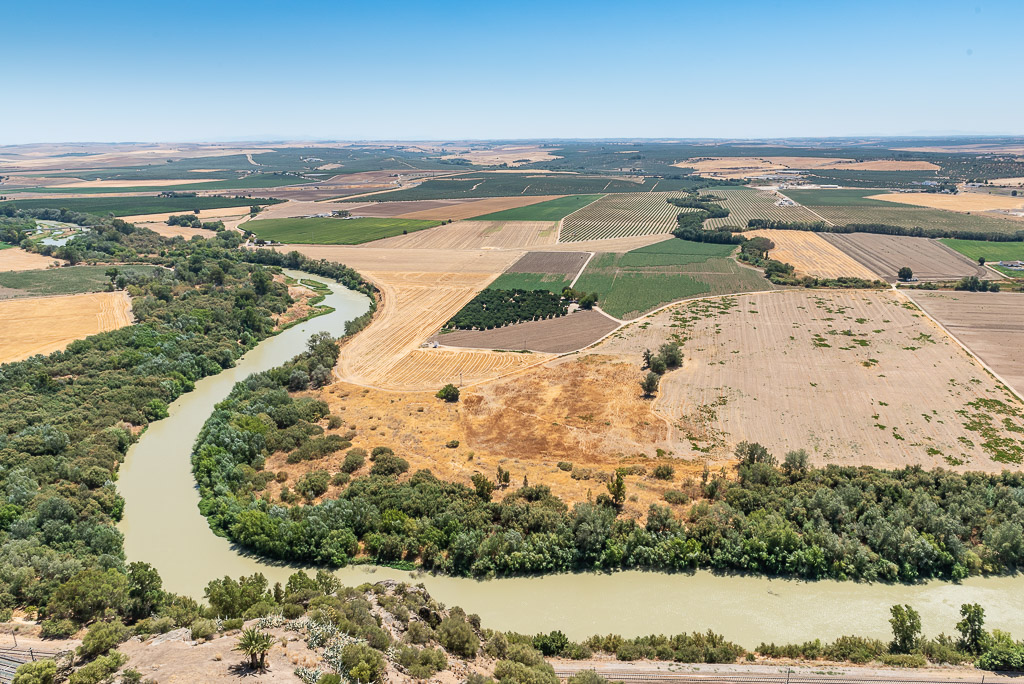
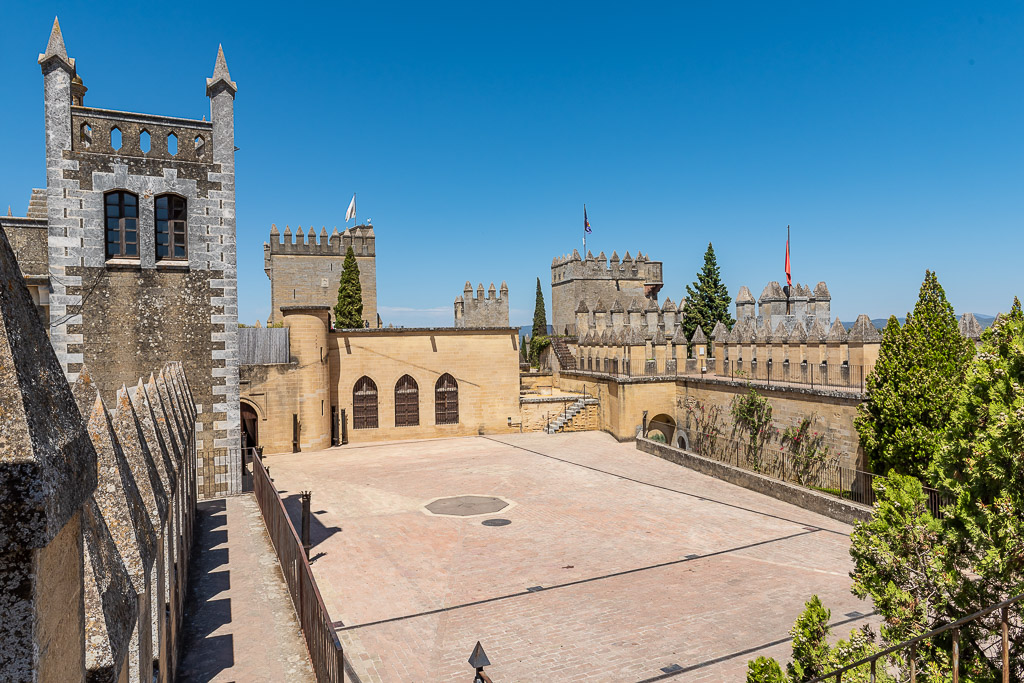
The Castle of Almodovar del Rio  played an extremely important role in the defense of the surrounding area because of its strategic location on a hill, next to the river Guadalquivir. The traces of multiple cultures, including Islam and Christianity, can be demonstrated in the architectural style of this unique building. In the year 756 this fort became the estate of the Moorish prince Al’del Malik Ben Qatan and from 758 it fell into the hands of the emirate of Cordoba in the reign of Abderraman I.

Castillo Almodovar del Rio

In the 19th century, Almodovar del Rio was known as Almudawar Al-Adna, while the castle was called Castillo de Almudawar. During the 10th century it was completely tied to the Caliphate of Cordoba, and in the 10th and 12th centuries it belonged to the Taifa of Carmona, then to the Taifa of Seville and finally to the Almohad empire.

Moorish king Abed Mohammed de Baeza would later die at the gates of the castle in the 13th century in 1226, the year in which the fort fell into Christian hands after it was handed over to Fernando III “The Saint”.

From now on the castle would be subjected to successive extensions initiated by the Castilian kings D. Pedro I of Castile and Enrique II of Trastamara

Impressions

Palma del Rio

2 pm and our stomachs are starting to growl. Time to consult Tripadvisor. I see some good reviews for a restaurant in Palma del Rio, I launch Waze and off we go.

Upon approach, we think we have entered the wrong address, because the streets are deserted, all shutters are closed and nothing that even looks like a restaurant. Until we see one small parasol and a few chairs.  This might be it. And indeed, as we enter we are welcomed by a pleasant buzz.

And tripadvisor didn’t let us down. Casa Manolo appears to be a winner. A friendly waiter assigns us a table and we order two glasses of Protos (Ribera del Duero) .It tastes like heaven.
The suggestions look very tempting … After some hesitation, we decide upon a Ceviche, artichokes al Cordobese  (alcachofas al Cordobese), suckling pig with tempura vegetables (lechón confitado con verduras and tempura) and for dessert grandma’s cake (tarta de la abuela) and a turón ice cream (Helado de turón), all washed down with a few glasses of Protos and two coffees.

We pay a whopping 50 euros and leave all satisfied  !

Plaza Palma del Rio
Plaza de Andalucía
Palacio Portocarrero
Palma del Rio

Even though it is siesta time, we decide to drive up to the central square (Plaza de Andalucía) in Palma del Rio, which is deserted at this hour. Like all squares in Spain, it is surrounded by beautiful buildings, church towers and decorated fountains.

The heat is scourching, so we flee back into the car, turn on the air conditioning and continue our journey to Ecija, one of the lesser-known white towns of Andalusia. Ecija is located in the Campiña, an area that covers the countryside between Seville and Cordoba.

As we drive across the river and my eye catches the shady promenade. We park our car and decide upon a siesta under the stately poplars. We close our eyes, listen to the silence, the rustling of the trees and the rippling of the water. No living soul for miles around, because this city is known as the ‘frying pan’ of Andalusia. No shit. It’s 6 pm and 35 degrees in the shade. No wonder we are exhausted.
After this enjoyable break we are ready to attack the city, which seems deserted. It feels like everyone fled the town.
The compact center is dotted with Gothic and Mudéjar palaces, churches and baroque towers, hence its nickname ‘la ciudad de las torres’ or ‘city of the towers’. The Roman ruins, on the other hand, bear witness to a rich Iberian center. The city flourished in the 1st and 2nd centuries under the name Colonia Augusta Firma Astigi and provided the Roman Empire with olive oil, among other things.

In 1755 a devastating earthquake destroyed much of the town and many of the current church towers date back to the time when everything was rebuilt.
One of the more beautiful is the tower of the Santa Maria church, which is located on a square just off the Plaza de España.

Santa Maria kerk Ecija

Close by is the most iconic building of Ecija, the Palacia de Peñaflor. The 18th century palace cannot be visited inside, but you can enjoy the beautiful exterior with its curved facade, ornamental portal, wrought-iron balconies and remains of flamboyant frescos

Palacio de Peñaflor

Desperate for some refreshment, we flee into a cafe, but the air conditioners can’t handle the temperature, so we take to the terrace near the Santa Maria church and enjoy a refreshing cola and the view. Still only a few souls on the street. Is the Spanish interior really emptying ? Are all yougsters fleeing to the coast and abroad to find jobs ?  Many houses are for sale, but we also lots of buildings being completely renovated and refurbished. I sincerely hope that these beautiful white villages and towns will remain populated and that the soul, richness and history of the ‘real’ Spain will be preserved.

We will do our very best to keep promoting the beauty and authenticity of the Campo.


Not looking at the map, we follow our gut feeling and wander through the narrow streets, discovering picturesque squares, colorful facades and shady parks.

And surprise, surprise, we automatically end up at our car.

We have one last stop to make on this trip.  Estepa and its  ‘Balcon de Andalucia’.

From a distance we see the whitewashed town perched against the hillside. Following the signs to ‘Cerro de San Cristobal’ and ‘Castillo’, the highest point in the city we drive up to the highest point.

.

Views to die for

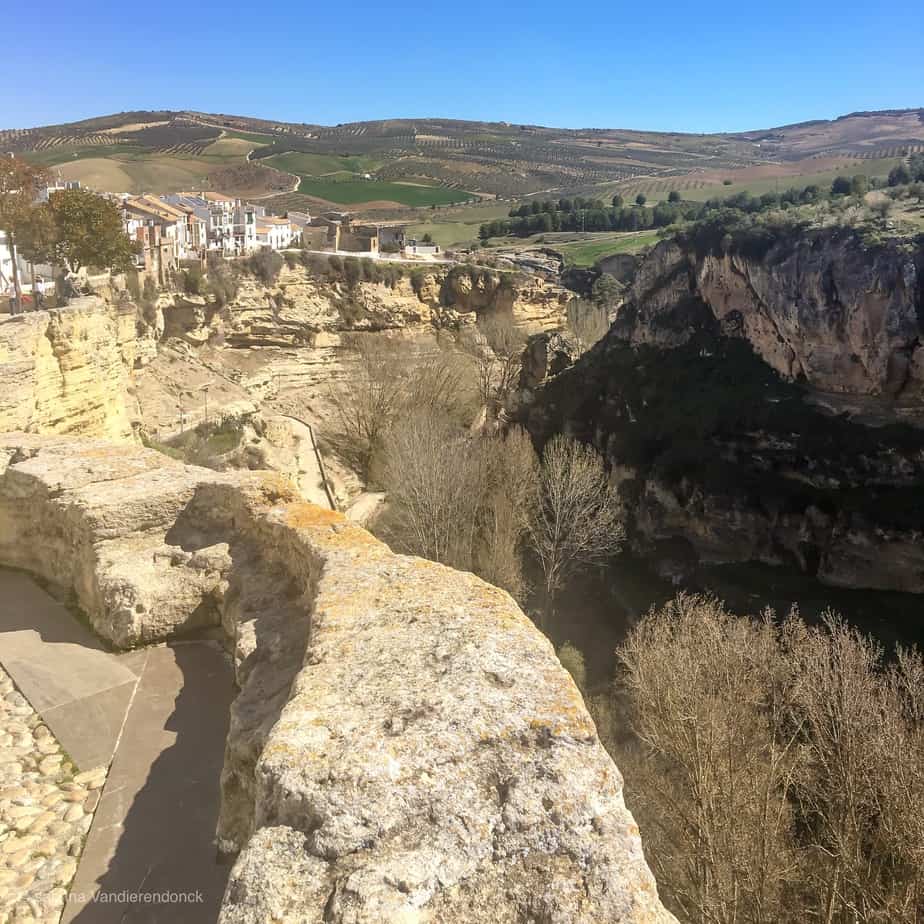
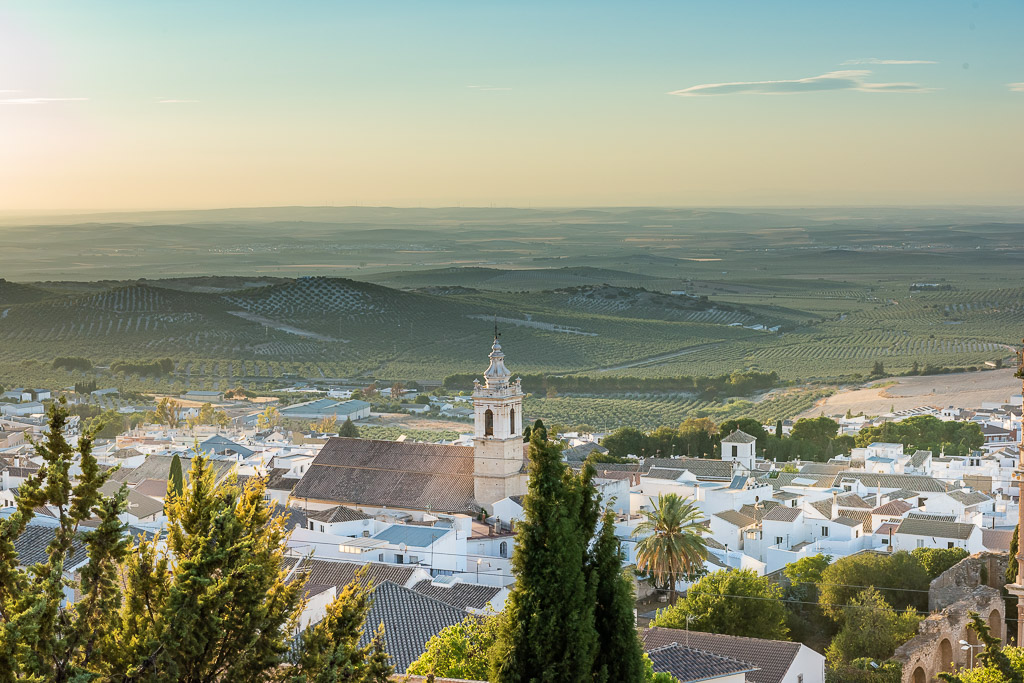
The view is breathtaking. We look out over the city, the surrounding olive groves and neighboring villages. It is a feast for the eyes.

The setting sun completes the picture.

A perfect end to a perfect day

Practical information and useful links

Map

Google Maps

BBC-1

History of Spain

BBC-2

History of Spain

BBC-3

History of Spain

Lonely Planet

General info about Andalucia

Medina Azahara

Official website of the ruins

Castillo

Castle of Almodovar del Rio

Casa Manolo

Casa Manolo at Palma del Rio

Ecija

Information about Ecija

Ecija

Info on Tripadvisor about Ecija

Estepa

Balcon de Andalucía

Cerro

Cerro de San Cristóbal

Alhama de Granada : Worth a daytrip

General Score

We have enjoyed Alhama. The city breathes culture and history. There are nice walks, restaurants & bars

Rated 4 out of 5

Distance

Situated about 60 km from our cortijo, it is the perfect day trip or stopover on the way to Granada or the coast.

55 min

must see

nature walks
city strolls
history
thermal baths

kloof

Facts

Do you like….

Then you’re in for a treat.

Information

There is also an app available for Android and Apple (search for ‘Alhama de Granada Turismo’ in the App Store) which is very user-friendly.
Upon starting the app you will be asked about your interests (nature walks, culture, gastronomy) and you will receive a number of routes that meet your requirements depending on your location.

Route planner

Must do

Our comments

Alhama has been on my wish list for a long time. Every time we were on our way to Granada, we passed the sign to Alhama, but we always passed it (other things to do, time constraints, etc.)
So time for action: a planned visit! many destinations within reach of our cortijo, it was not a disillusion. The city exudes history and culture from the moment you enter.

Be sure to visit the tourist office and ask for a city map. The office itself organizes a tour of the city in the historic center that is definitely worth the effort. mere amount of 3 € pp (really a bargain). It is also the only way to see all the monuments along the route from the inside (which are otherwise closed). There is a nice little prison museum on the Plaza de los Mesos (entrance 2 €).

There are 5 signposted nature walks, all starting from the viewpoint behind the monastery of the order “Carmelitas Calzados”

Top tip

Combine a nice walk (3 km only) with a lunch and follow the route to Humedal de la Pantaneta (a hydraulic reservoir from the 50s, classified as wetland of Andalusia in 2010). There are two restaurants on the shore of the lake :
• Meson rural El Ventorro
• Restaurante Asador El Pato Loco
You can also drive there and take the route to Jatar from the city center. This is also the route to the ‘Sierra de Tejeda’ national park just south of Jatar on the way to the coast. (see next blog post).

go thermal

The thermal baths are located 2 km outside the city in a hotel complex. The historic baths are only open to the public at certain times and days of the week (from 8 April 2019 to October 2019).

Just outside the hotel are 2 small baths that are open all year round at a constant temperature of 35°C. They are free to the general public. For more information, visit the website: www.balnearioalhamadegranada.com

Our Opinion

As you can see, Alhama is the perfect day trip from our cortijo, or nice lunch stop on the route to the Sierra de Tejeda and further on to the coast (La Herradura, Nerja or Malaga). Watch out for one of the following blog posts.
Do you have questions or suggestions? Do not hesitate to contact us or leave a comment.

Casa Piolas revisited

It has already been a year since we last visited Casa Piolas. back then, we were pleasantly surprised in every sense of the word.

The restaurant is hidden in a small street near a small square in Algarinejo, a village in the heart of Andalusia, an hour’s drive from our Cortijo.

But behind the walls of this simple facade a true spectacle unfolds.

The chef

Chef José Caracuel, who has run the restaurant for over 20 years, knows how to combine tradition and creativity like no other. He works exclusively with local products which he presents in a very original way. His dishes are a true delight to the eye and to the taste buds.

The formula

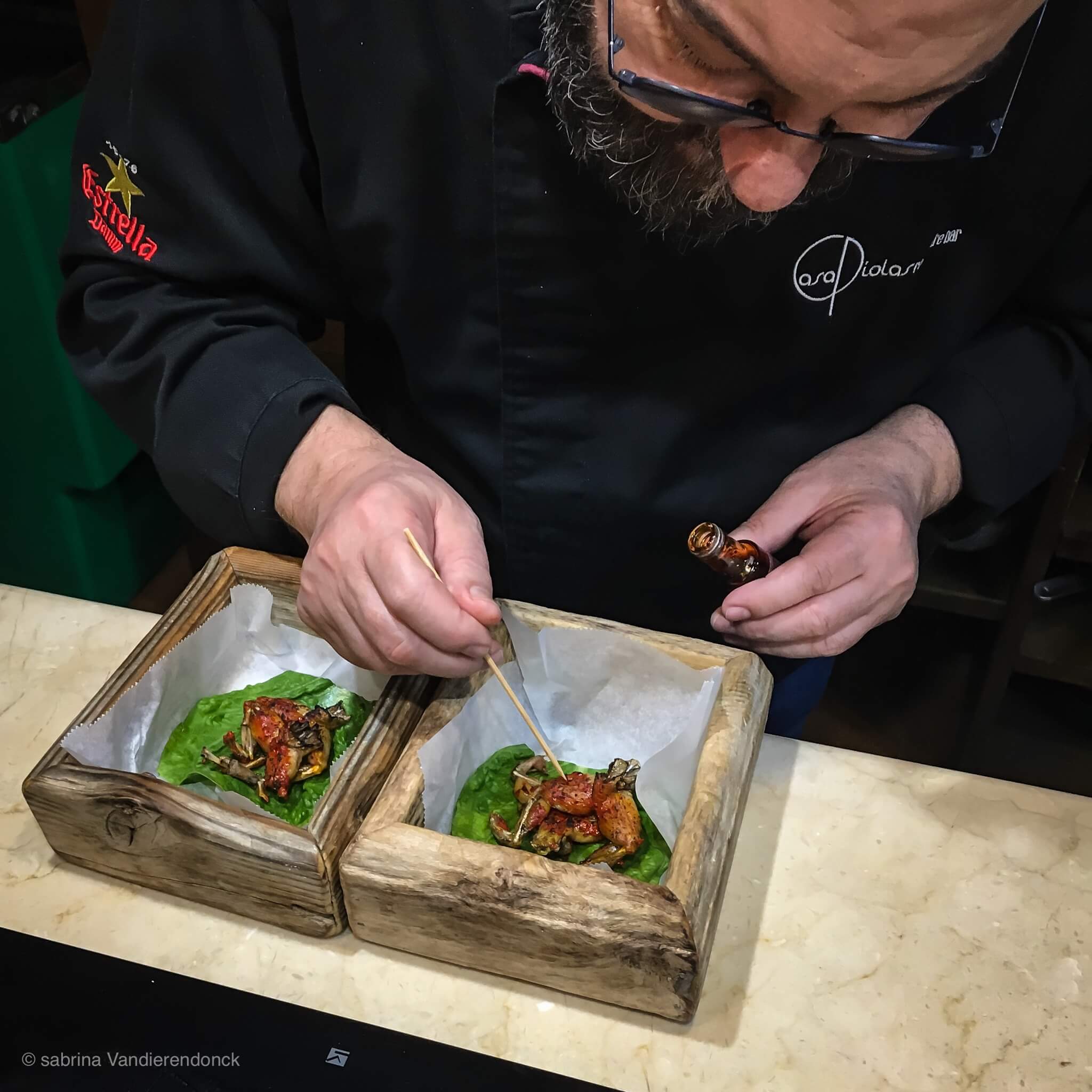
And to our surprise, he has slightly changed his formula to give his guests a more exclusive experience. This time we’ll go for the ‘full option’ and choose the tasting menu with pairing wines. The aperitif and accompanying snacks are served in a separate room adjoining the kitchen and the chef prepares them à la minute and comments on his actions with the necessary Spanish passion.

Aperitif

We start with a Fino from Montilla and a Vermouth, both from the region, accompanied by a series of olives in all shapes and flavors. He explains that he is interested in the true flavors of the olives, which are still the main product of this region. Most people literally throw a jar of olives into a bowl and gobble them down. This is not the way to enjoy food. That is why Chef José prepares each olive separately and attaches a story to them.

His ‘pièce de résistance’ is the ‘Rita Hayworth’ skewer, because according to him it imitates the shapes of the American actress (who is Spanish in origin he also tells us). The skewer has to be eaten in two stages, first the spicier, salty part and then the softer, sweeter to temper the flavors.

Entrées

The first starter is also presented in the kitchen. Flambéed legs of frog. He used to catch them himself as a child in the river and they were often found on the menu in the region. In recent years though, they have vanished alsmost completely for ecological reasons. However, The chef wants to reintroduce the dish  with respect for the product and he prepares it for us with lots of love.

Main courses

After the snacks and the starter we are professionally escorted to the restaurant where a table has been prepared for us. What follows is a succession of beautiful, exquisite dishes that caress the eye and tongue, all paired with tasteful white and red wines to complete the experience.

All dishes are also presented with the necessary professional comments from our Argentinean waitress. She’s from Buenos Aires but ended up in Algarinejo for love. With her soft South American Spanish accent she brings every dish to life.

This is what is so charming about Casa Piolas. You get a Michelin star cuisine, but with a cozy, homely and warm Spanish charm. The perfect combination.

Finally

To top it all off we end with a nice coffee and the obligatory ‘chupito’.

We’re glad to have come and promise ourselves that we will not wait another year for the next visit.

We say thank you and see you soon !


Would you also like to be pampered, do not hesitate and book your seats online.

Restaurante Campo de Golf

Golfers can enjoy the beautiful greens that lie in the run-up to the El Torcal mountain range. But you do not necessarily have to practice the sport to enjoy the restaurant.
there is a cheap lunch (12 euros pp for the menu del dia) or you can just enjoy a glass of wine on the beautiful terrace overlooking the golf course or inside the panoramic restaurant or you can choose the more formal menus and à la carte dishes.

Amazing Views

from the restaurant terrace

Enjoy

a salad or a menu del dia

Relax

after a game of golf

Play

and enjoy views, sun, and nice food

In the evening you can also enjoy a BBQ on the terrace in summer or a ‘Menu de Leña’ at the restaurant in winter.
On the website you will find the opening hours and the complete menus.

Walking to get fit

The fitness routes are a super initiative from the Ministry of Health and Welfare. They promote routes that are specially designed to keep the local population healthy and fit. And of course we can also benefit from this

Six signposted routes

Archidona has a total of six such routes within the city limits and three in adjacent hamlets. They differ in length and difficulty and are adjusted according to the needs of each person.

The table in PDF at the bottom of this post shows all useful information about these routes, such as the distance, average duration and estimated calorie consumption. This information should enable you to better estimate and plan the physical effort.


The routes are marked red, blue and green, depending on their level of difficulty.

Route 1, in red is the most difficult, takes an average of 2 hours and is 10 km long, which corresponds to a calorie consumption of 837 kilocalories.

The routes 2 and 3, in blue, have an average degree of difficulty.

Routes 4, 5 and 6 in green are the easiest.

There are also 3 routes that are outside the city limits (7, 8 and 9, in yellow).

Sierra of Archidona

Sierra de archidona

In the Sierra of Archidona you can make beautiful walks where you can admire Archidona, Antequera and the surrounding area from a height. Try to plan these walks in the spring, autumn or even on a beautiful winter day, because in the summer they can be quite exhausting due to the heat. Here we describe two routes that you can or can not shorten depending on your abilities and endurance.

Route 1

The first route crosses the Sierra de Archidona. The starting point is at the Plaza de la Victoria. The stops along the way are: the Sierra de la Virgen de Gracia (chapel on the hilltop with beautiful views), the Pico del Conjuro and the Sierra de las Grajas. The difficulty level is average.
Sierra de Archidona
The first part of the route up to the Sierra de la Virgen de Gracia (chapel) is hardly a problem, but the second part with the Pico del Conjuro and especially the Sierra de las Grajas requires a greater effort. An option for people who do not see this is that you skip this part of the route. When you come from the Pico del Conjuro you can take the dirt road that takes you to the Puerta de la Hoya, which then ends at a point just before the last part of the loop.
The last part of the route starts when we leave the Sierra del Conjuro behind and we enter the Sierra de las Grajas. We get to the base of the rock of the Cueva de las Grajas. For the more adventurous among you, there is the possibility to climb the rock. As soon as the descent has started, we will encounter the Cueva de las Grajas. After enjoying this wonder of nature, we can return to the city center and enjoy a refreshing pint on the square or continue the walk to the starting point.

Route 2

The second route shown on the map at the bottom of the page also starts at the Plaza de la Victoria, but it takes us to the industrial area, where we take the road to Fuente Sacristán until the end of the industrial estate. Instead of walking down this road, we turn left and follow a path that runs along the mountain until we reach a point where the road splits again. Then we keep to the left and a few meters further, near the era of the Carilla Claveles, we take a path to the left of us that goes up the mountain. further on we reach an olive grove, where we walk around until we reach the Cortijo del Chopillo (now a ruin); In this area you can still see the remains of the old walled city.
A little further, the route connects to the previously described route and you can follow it further, albeit in the opposite direction, through the Sierra de Conjuro further to the Sierra de la Virgen de Gracia, from where we return to the starting point of the route.
Sierra de Archidona

If you have walked this route, please let us know what you think and leave your comments below.